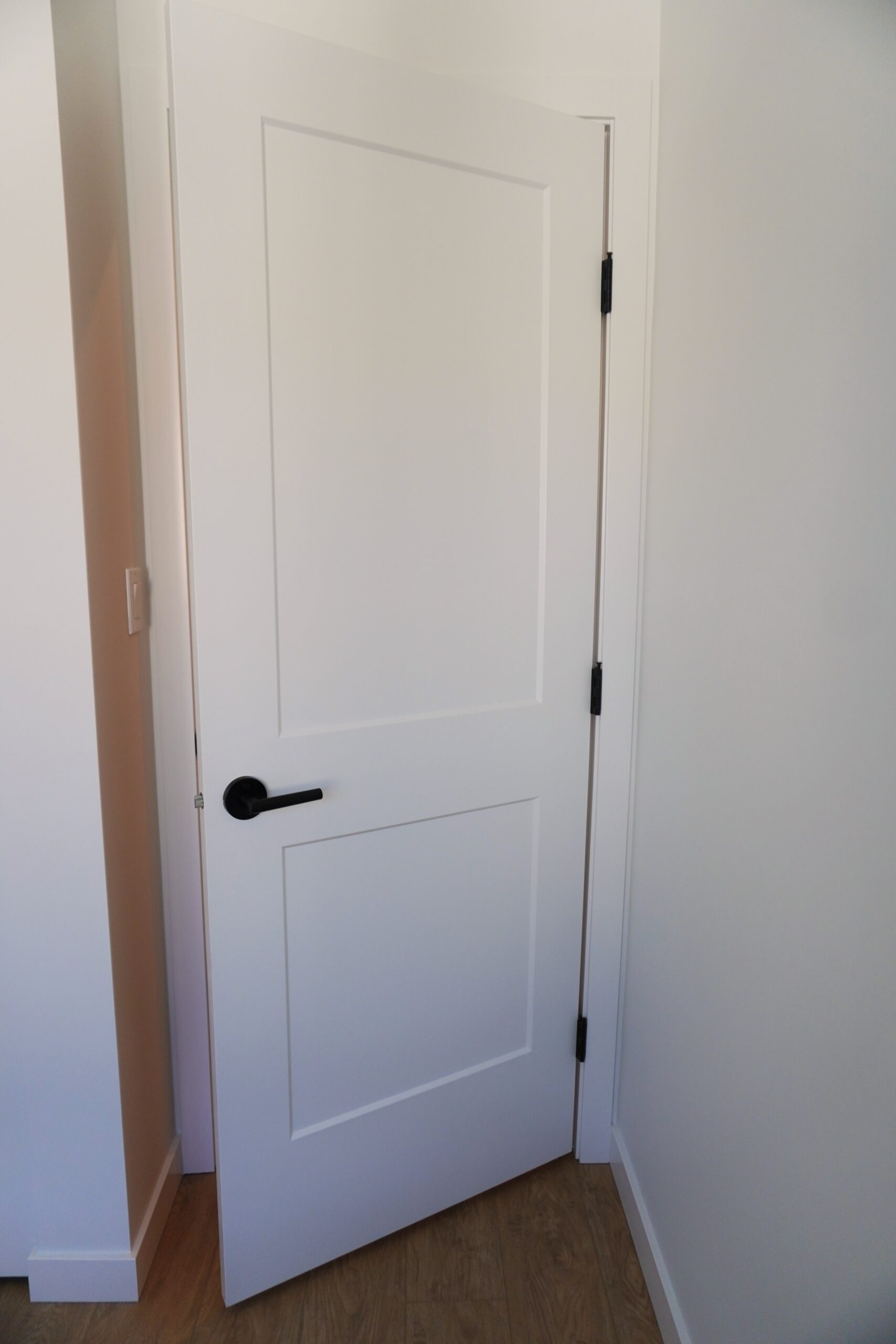
The everyday door type that quietly does its job in nearly every room. Here's what to know before you choose one.
When most people picture a door inside a house, they're picturing a standard interior door. It's the swing-style, hinged door you find in bedrooms, bathrooms, home offices, and pantries. Standard doesn't mean boring — it just means this is the most familiar, versatile, and widely available door category.
Standard interior doors come in several constructions (hollow-core, solid-core, MDF) and many style profiles (flat slab, Shaker, panel, French). The right combination depends on the room, your budget, and how the door will be used day to day.
Compared to bifold or barn doors, standard doors are the easiest to install, the easiest to replace, and the most predictable in terms of performance. If a room doesn't have a specific space constraint or design statement to make, a standard door is almost always the right starting point.
Sound dampening matters here. A solid-core standard door gives much better noise isolation than hollow-core, which makes a real difference between rooms in a busy household.
Privacy is the priority. A standard swing door with a privacy latch handles this perfectly, while bifold or barn doors leave gaps that compromise privacy.
A door that fully seals helps reduce hallway noise during calls or focused work. Standard doors with proper weatherstripping make a small but noticeable difference.
For walk-in closets and large pantries, a standard hinged door provides full access without the track maintenance that bifolds need.
All three look similar from the outside, but they behave very differently. Here's the honest breakdown.
Lightweight construction with a honeycomb cardboard or composite interior between two thin wood panels. Cheap, light, easy to hang.
Best for: closets, pantries, and rooms where sound and durability don't matter much. Avoid in bedrooms and bathrooms where noise isolation or impact resistance matters — hollow-core dents and transmits sound easily.
Engineered wood interior with a hardwood or veneer surface. Heavier, sturdier, much better at blocking sound and resisting damage.
Best for: bedrooms, primary suites, home offices, and bathrooms. The upgrade from hollow-core to solid-core is one of the highest-impact, most-overlooked improvements you can make during a renovation.
Dense, uniform engineered panel often used for paint-grade doors. Takes paint beautifully, doesn't warp like real wood can.
Best for: when you want a clean, painted finish (especially white) and don't need natural wood grain. Cost-effective, stable, and the same MDF used for premium baseboards and trim — so it's a natural match for an all-white interior.
For a pre-hung door replacement where the frame is in good shape, expect about 2 to 4 hours per door including casing trim. If the frame needs to be replaced or the opening adjusted, it can take longer.
You can, but it often costs more overall. We can advise on the right door type, hardware, and finish for your space, and our supplier pricing usually saves homeowners money compared to retail. We're happy to do install-only jobs too — just bring questions.
Often yes, if the frame is plumb (vertically level), square, and in good condition. We assess this during the on-site visit. If the frame needs work, we'll explain what's required and what it adds to the quote.
Most homeowners choose factory pre-primed doors that we install raw, then we coordinate with your painter (or our partner painter) for the final coat. This produces a cleaner, more durable finish than pre-painted doors that get nicked during install.
We install standard interior doors across the Greater Edmonton Region. Get a free, detailed quote with no obligation.